Craft, Community, and Colour: The Story of Raghurajpur

Have you heard of Raghurajpur?
It’s not just a village—it’s a living art gallery.

Located in Puri district, every house here tells a story. Literally. The walls are painted by local artisans, each one reflecting centuries of cultural memory. Over 500 Chitrakar families live here, practicing Pattachitra—an art form that has survived generations without losing its soul.

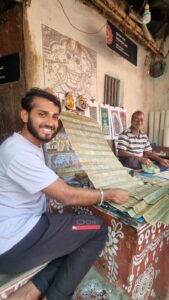
I spoke with Mr. Sipun Das, a 7th-generation Pattachitra artist, and that conversation alone was enough to understand how ancient and deeply personal this tradition is. Here, painting isn’t a profession—it’s inheritance.
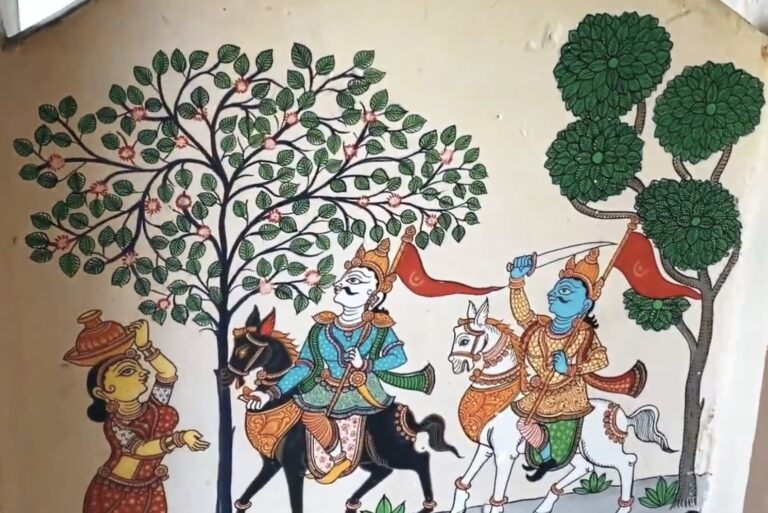
Walls of Raghurajpur
Artisan Sipun Das with his father
Artisan Sipun Das from Raghurajpur

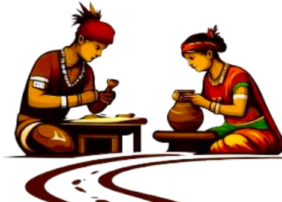
The Canvas Comes First

Before a single line is drawn, the Patta (canvas) is prepared. And that itself takes 2–3 days.

Layers of cotton cloth are pasted together using glue made from tamarind seeds. Chalk mixed with this glue is applied on both sides, left to dry overnight, and then polished smooth with a stone. Only after trimming the edges is the canvas ready. Slow. Intentional. Almost meditative.

Stories on Palm Leaves

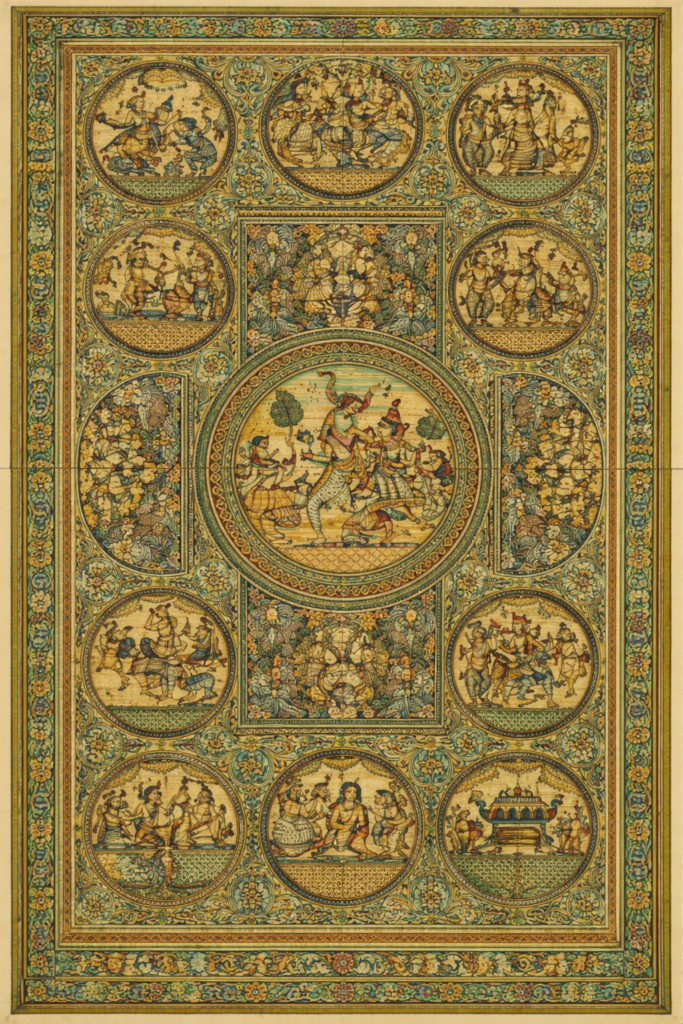
Then there’s Talapatra Chitra—stories etched onto palm leaves.
Palm leaves were among the earliest writing materials, dating back to the 7th century AD. Even today, artisans stitch and engrave them by hand. One artwork can take 6–8 months to finish, which is why these are rarer and more expensive

Talapatta chitra from life of Krishna

Pattachitra is more than a painting style—it’s storytelling on cloth. Each artwork unfolds a familiar tale, one frame at a time, drawn from mythology, ritual, and lived faith.

1. Jatti Patta

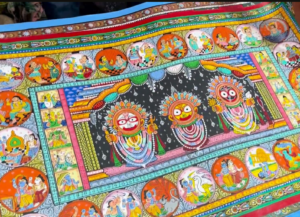
This is the most sacred form of Pattachitra. The themes revolve around Lord Jagannath, the Rath Yatra, different avatars of Vishnu, and the many shrines of the Puri temple. These paintings feel devotional—almost like visual prayers.

Paintings of Lord Jagannath
Jatti Patta

2. Kanchi Abhijan

This is one of the most powerful stories in Pattachitra.
Every year during Rath Yatra, the King of Puri sweeps the chariot of Lord Jagannath, Balabhadra, and Subhadra—symbolising that everyone is equal before God.

According to legend, King Gajapati Purushottam Deva was insulted by the King of Kanchipuram for performing this act, being called a mere sweeper. Hurt and humiliated, he returned to Puri. It is believed that Lord Jagannath himself came to his aid, helping him defeat the Kanchi king and marry his daughter.
This entire episode is painted in rich detail and is known as Kanchi Abhijan.

3. Krishna Leela

These paintings bring Krishna’s life to canvas—his birth, childhood pranks, the defeat of Kansa, Radha–Krishna moments, and the joyous Raas Leela. They’re vibrant, playful, and deeply emotional.

Paintings of Krishna Leela

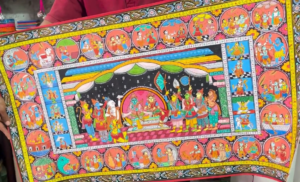
4. Ramayana

This series visually narrates the epic journey of Shri Ram—from his 14-year exile to the battle with Ravana. Scenes like the building of Ram Setu, Hanuman carrying Gandhamardhan, Lakshman’s battle with Indrajit, and Sita’s Agni Pariksha are rendered with remarkable detail.

.

5. Mahishamardini Durga

Often painted in a striking black-and-white palette, this form shows Goddess Durga slaying Mahishasura. With eight arms holding weapons like the trident, sword, and bow, the goddess rides her lion, symbolising the victory of good over evil.

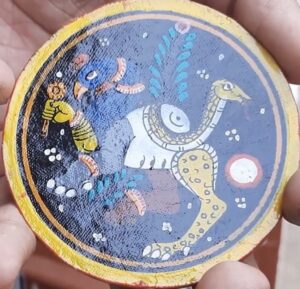
6. Ganjappa / Ganjifa Art

These are traditional circular playing cards, hand-painted in Pattachitra style.
Originally from Persia, Ganjifa reached Mughal courts in the 16th century and became popular in Odisha by the 18th century. A standard set has 12 cards, and a full deck may have multiple sets—sometimes 96 cards in total, each in different colours.

Ganjifa card
Ganjifa card

Colours of the Earth

Only six natural colours are traditionally used:

  • Black from charcoal

  • White from limestone

  • Red, yellow, and blue from coastal stones

Mixed with tamarind-seed glue, these create 23 natural shades—soft, earthy, and long-lasting.

Cost & Craft Value

  • Palm-leaf (Talapatra) paintings are the most expensive due to time and skill.

  • Cotton Patta paintings usually range from ₹2,000 to ₹3,00,000, depending on size, detailing, and finish.

Every piece carries time, patience, and generations of memory.

Leave a Comment

Your email address will not be published. Required fields are marked *

Scroll to Top