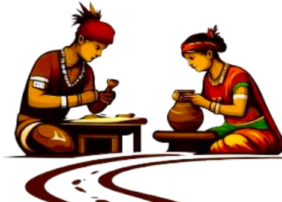
Last autumn, in the month of October, I found myself in Tera village, in the Kutch region of Gujarat. It was there that I came across the Khatri community—the true flagbearers of Bandhani, or Bandhej. For them, Bandhej is not merely a textile tradition or an occupation; it is ibaadat—an act of devotion.
The sarees were presented to us in their twisted, tied condition, just as they come out of the dyeing process. Each saree had already been dipped multiple times into dye, absorbing colour while the knots resisted it. There were thousands of tiny dots holding the fabric of saree together.
When the moment came, the artisan slowly unfolded the fabric.
What revealed itself was pure magic.
Bandhej sarees are breathable, quick to dry, and gentle on the skin—qualities shaped by centuries of living in hot, arid climates. Watching the saree move lightly in the breeze instantly took me back to my childhood. I remembered my mother wearing these Bandhej sarees especially during summers, choosing them instinctively for their comfort as much as for their beauty.
In the world of Bandhej, value is never measured by surface glamour alone, but by skill, patience, and time.
History of Bandhej
Bandhani, or Bandhej, is over 4,000 years old originating from Indus Valley Civilization. One of the earliest visual records of Bandhani can be seen in the Ajanta Cave I paintings, depicting scenes from the life of Buddha, where women from royal households are shown wearing garments with dotted Bandhani patterns.
In Gujarat, Bandhani has traditionally been practiced in towns such as Pethapur, Mandvi, Bhuj, Anjar, Jetpur, Jamnagar, and Rajkot. While Bandhani is also made in Rajasthan—where colours and designs differ—in Gujarat it has been exclusively preserved by the Khatri community, who are also known for other textile traditions such as Ajrakh.
About the Khatri Community
The Khatri community of Kachchh is a historically significant group of artisans renowned for their mastery of resist dyeing, block printing, and natural dyeing techniques. They originally migrated from the Sindh region of present-day Pakistan to Kutch. Their ancestors were hindu warriors, some groups converted to Islam over time.
Before Partition, Khatri artisans sourced raw materials from Sindh. The Partition of 1947 and with growth of industrialisation, the prefence of people shifted deeply impacted the livelihood of the community.
Despite these challenges, approximately 100,000 Khatri artisans in Kutch continue to practice Bandhej to this day, keeping the craft alive.
Fabric and Costing
Bandhej is traditionally made on cotton and silk and gradually added in georgette and Chiffon. The raw material is sourced from Benaras (UP), Surat (Gujarat) and Madurai (Tamil Nadu).
A Bandhej saree is valued based upon the size and no of dots present in fabric because this process is time taking requiring weeks or months . These dots—usually white or yellow—are the marks left behind by the knots. The finer and more numerous the dots, the greater the labour, precision, and time invested, and therefore, the higher the cost.
Bandhej is available in bright as well as deep colours, and comes in the form of sarees, suit pieces, and dupattas. Prices range from approximately ₹1,000 to ₹40,000, depending on fabric and intricacy.
Step-by-Step Process of Making Bandhej (Bandhani)
Bandhej is one of the most intricate hand-dyeing techniques in the world. Each step demands patience, precision, and experiential knowledge.
Step 1: Washing and Preparation
The fabric is thoroughly washed to remove starch, oils, and impurities.
Step 2: Design Marking
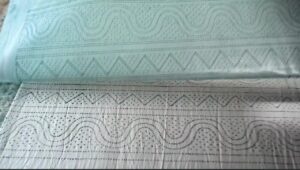
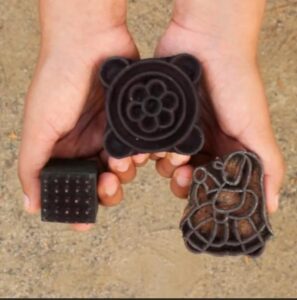
Designs are created either by tracing patterns on paper using fine needles or by using wooden blocks. These designs are printed by placing the trace paper or block onto the fabric and transferring the pattern using charcoal or a locally prepared temporary colour known as kuccha rang.
Step 3: Tying the Knots (Bandhna / Bheendi)
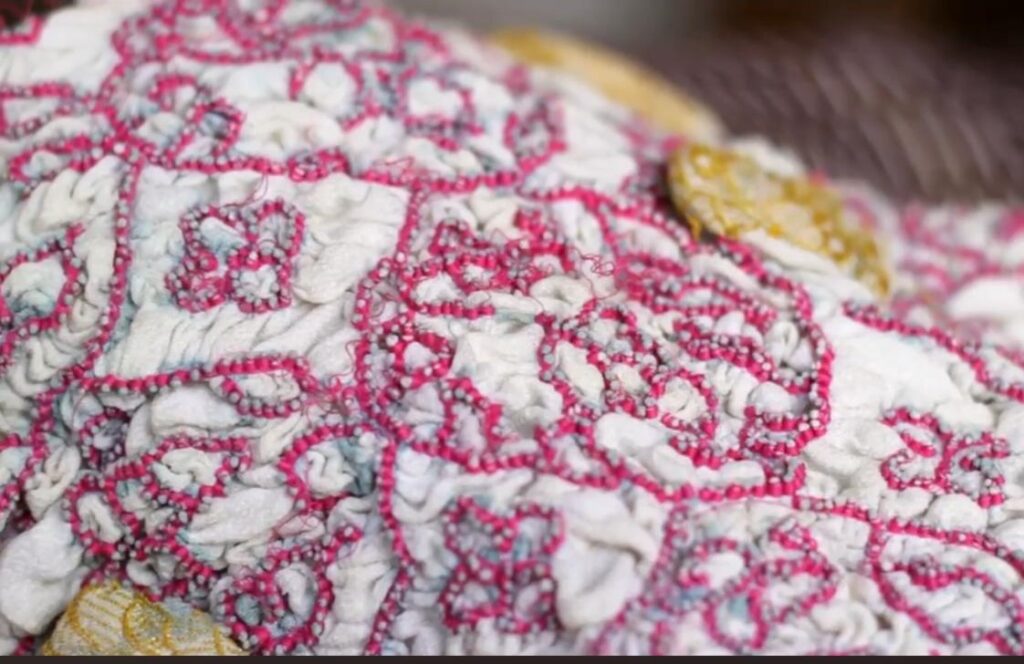
Women or elders in the family pinch tiny portions of fabric using fingernails or metal pins and tightly tie them with cotton thread.
Thousands of knots are tied on a single saree. Since this process is extremely time-intensive, the cost of the saree increases with the number of dots.
Step 4: First Dye Bath (Lightest Colour)
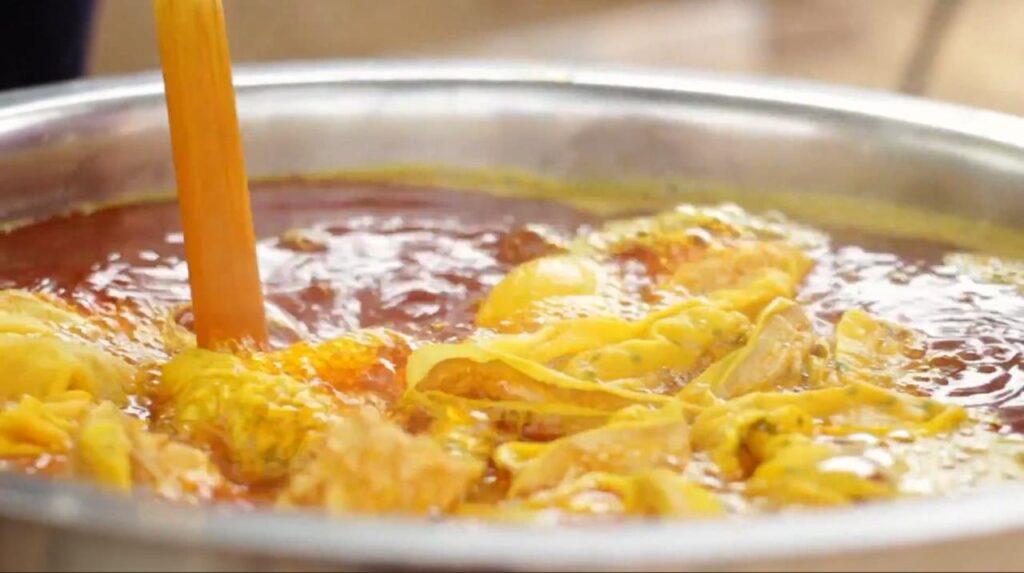
The saree is first dipped in a light colour, usually yellow, and dried. Both natural and synthetic dyes are used.
Step 5: Re-tying for Multiple Colours
Bandhani is made in nearly 500 different shades. For multi-coloured sarees, some knots are opened, new ones are tied, and the fabric is dipped into different dyes.
This cycle of tying → dyeing → drying may repeat several times.
Step 6: Final Dye and Fixing
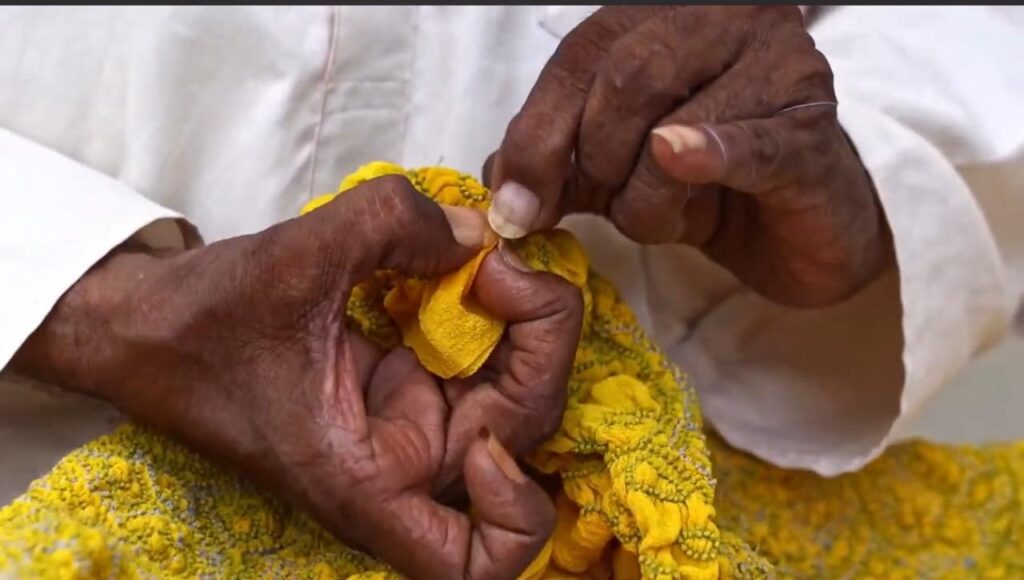
The darkest colour is applied last from a palette of more than 500 colors based upon customer demand and popularity.
Step 7: Unknotting and Unfolding
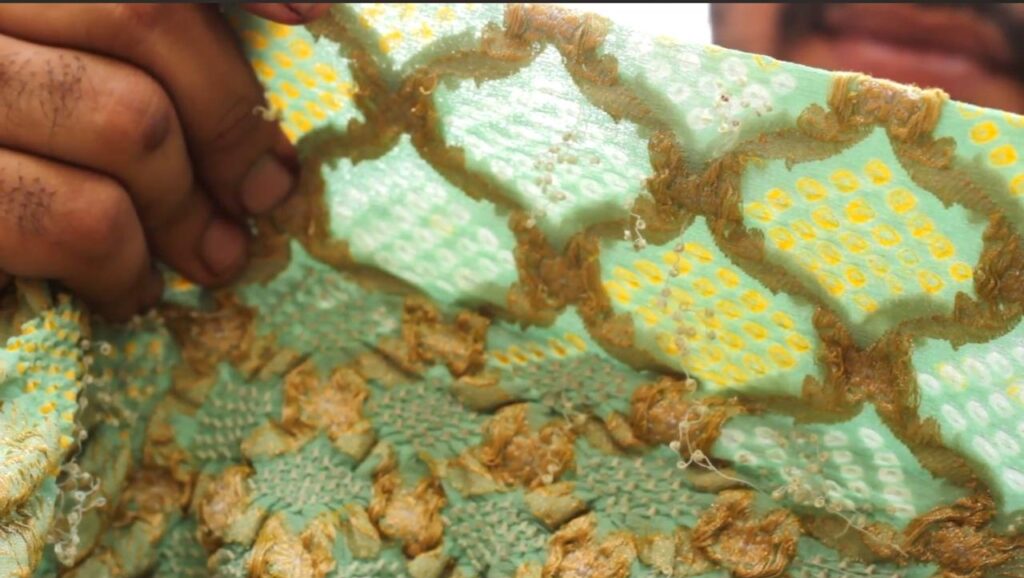
After completing the dyeing with desired color, the saree is dried and each knot is opened manually and the saree is stretched carefully to avoid tearing.
Step 8: Final Wash & Softening
The saree is washed again to remove remaining threads, soften the fabric, and enhance drape and breathability.
Step 9: Drying & Finishing
The finished saree is sun-dried, lightly ironed, folded, and stored. It is now ready for the customer.
Types of Bandhej Pallu
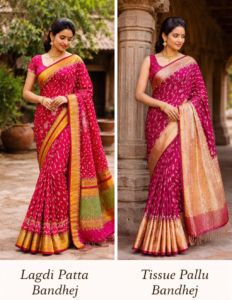
The pallu—the loose end of the saree worn over the shoulder—is available in two styles: Lagdi Pattu and Tissue Pallu. “Lagdi”
means “attached”, a separate pallu is stitched in fabric of saree after the
dyeing is complete. It is lighter in weight and more affordable. “Tissue” refers to metallic zari based pallu. It is woven in pallu before bandhej process begins. It is slightly heavier and costly.