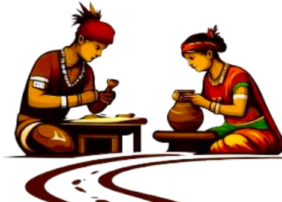
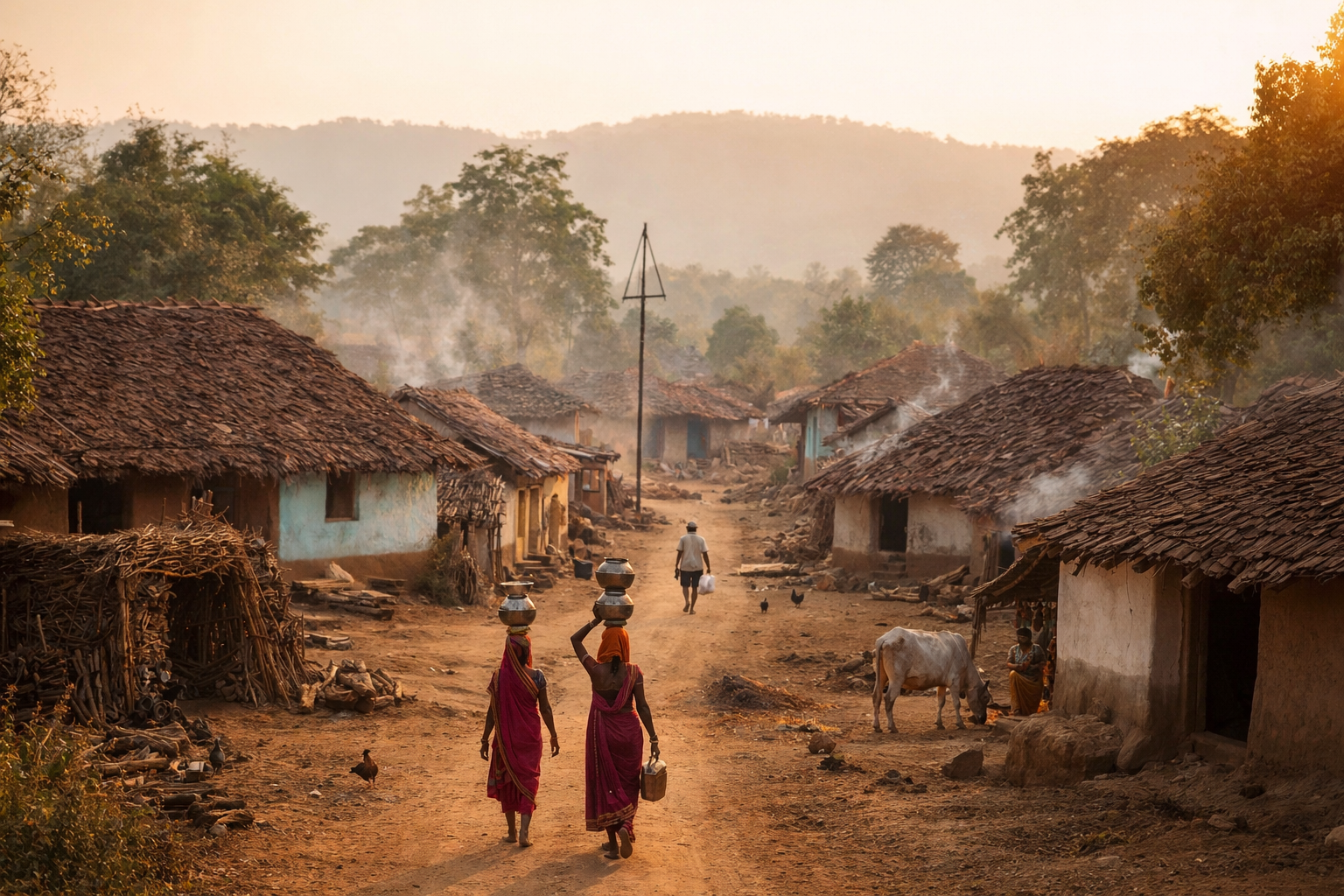
India’s crafts but real stories live in small villages—beside mud kilns, wax-coated clay forms, and families working together.
One such story belongs to Mr. Nandlal Vishwakarma, a Dhokra metal artisan from Umargaon village near Kondagaon, in Chhattisgarh. He has been practicing Dhokra art since the age of eight, carrying forward a tradition that is over 4,500 years old.
A Childhood Forged in Fire and Clay
For Mr. Vishwakarma, Dhokra was never a career choice—it was a way of life.
As a child, he learned by watching elders prepare clay, melt wax, and pour molten metal with bare-minimum tools but extraordinary skill.
Today, his work includes:
- Brass and wrought-iron candle stands
- Door handles
- Tribal figurines
- The culturally significant Laxman Diya
What makes his practice unique is that his entire family of eight members participates in the process—each contributing to different stages of making. This is not his personal story but his entire community. It takes the participation of an entire family to prepare an artefact.
The Laxman Diya: A Ritual, Not Just an Object
When Mr. Vishwakarma talks about the Laxman Diya, his enthusiasm is unmistakable.
In many tribal households, this diya is used to initiate marriage ceremonies.
Families of the bride or groom place special orders for it, and it is lit to mark an auspicious beginning for the newlywed couple.
The diya is often preserved for life—kept in the home as a reminder of beginnings, continuity, and blessings.
In Dhokra, function and faith are inseparable.

What Is Dhokra Art? A Brief History
Dhokra art takes its name from the Dhokra–Damar tribes, who traditionally made metal artefacts in exchange for grains under a barter system.
- Practised across Chhattisgarh, Odisha, Jharkhand, West Bengal, and Telangana
- Created by Ojha metal-smith communities
- Among the oldest metal casting traditions in the world
The earliest known example of this technique is the iconic Dancing Girl of Mohenjo-daro, dated to around 2300 BCE.
The Lost-Wax Casting Process (Cire Perdue)
Every authentic Dhokra piece is made using the lost-wax casting technique, ensuring that no two pieces are ever identical.
Step 1: Clay Core
A rough shape is made using local river clay mixed with rice husk or sand and sun-dried for 1–2 days.
Step 2: Wax Modelling (Most Critical Stage)
Natural beeswax mixed with tree resin is applied over the clay core.
Wax threads—made using a traditional wooden press or hand-rolled—are used to create all surface details like eyes, jewellery, textures, and tribal motifs.
Step 3: Outer Clay Mould
Multiple layers of clay are added. Funnels and air vents are formed to allow wax to escape later.
Step 4: Firing & Wax Loss
The mould is heated in a temporary kiln made of bricks and wood, reaching nearly 1300°C.
The wax melts and drains out, leaving a hollow cavity.
Step 5: Molten Metal Pouring
Molten brass or bell metal (900–1000°C) is poured into the cavity and left to cool naturally.
Step 6: Breaking the Mould
The clay mould is broken open and destroyed—this is why every Dhokra piece is one-of-a-kind.
Step 7: Finishing
The surface is polished using sandstone, tamarind solution, or leaves. Some pieces are left matte; others are polished for shine.
A Day in Mr. Nandlal Vishwakarma’s Workshop
- Working hours: 8–10 hours a day
- Time to make one medium Dhokra piece: 5-7days
- Monthly production capacity: 15–25 pieces
- Raw material + fuel cost per piece: steadily rising
- Income stability: highly uncertain
Despite generations of skill, Dhokra artisans often earn less than minimum wage once costs are deducted. As a result the population of Dhokra artist has reduced to 1/3 in last 3 decades.
Rising Costs and Shrinking Margins
Until the 1980s and early 1990s, raw materials were freely available.
- Mr. Vishwakarma’s father travelled 10–30 km by bullock cart to collect stones and metal
- Today, materials must be purchased from markets:
- Brass: ₹400 per kg
- Wrought iron: ₹100 per kg
On top of this, GST has added complexity.
Small artisans struggle to understand Input Tax Credit systems, often paying taxes without receiving benefits meant for larger businesses.
Economic Shocks: Demonetisation and COVID-19
- 2016 Demonetisation: No cash circulation meant no buyers
- COVID-19 Pandemic: Work stopped entirely; income fell to zero
Like many traditional artisans, Mr. Vishwakarma endured both crises quietly—without safety nets or institutional support.
How to Identify Authentic Dhokra Art
How to Identify Authentic Dhokra Art
- No two pieces are exactly the same, every piece of same artist may differ.
- Slight irregularities are normal (and desirable)
- Heavier than it looks due to solid casting
- Fine wax-thread detailing visible on close inspection
- The artisan can clearly explain the lost-wax process
If it looks too perfect and identical—it probably isn’t Dhokra.