Far from the hustle and bustle of big cities lies the small town of Champa—its air often heavy with coal dust from nearby mines.
It is hard to imagine that this town, marked by industrial residue, is also home to a vast population of silk weavers who have carried their craft forward for generations.
I visited Champa on a cold winter morning in December, driven by a simple curiosity—to see a handloom in action. When I asked a local gentleman about the weaver community, he guided me without hesitation to Seoni village, located about five kilometres from the city. The village was easy to access, but what awaited there was far from easy to process.
The first person I met was Mr. Shankar Lal Dewangan. Despite his busy schedule, he immediately agreed to take me to his friend’s house—a weaver. This warmth and willingness to help was my first glimpse into the quiet generosity of the community.
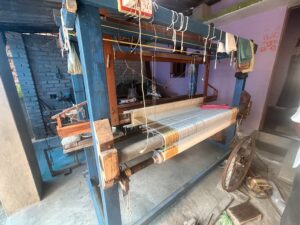
As I approached the houses, one sound became constant in the background—the rhythmic clatter of the handloom.
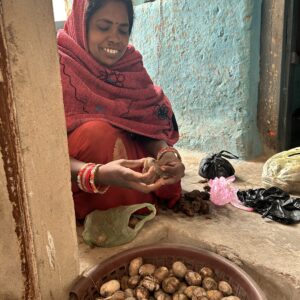
I entered the home of Hemlal Dewangan, where a family of four was fully engaged in the weaving process. His wife and daughter were boiling cocoons and spinning yarn, while Hemlal and his son operated the loom. The experience was immersive, almost overwhelming—every corner of the house was alive with labour.
As we spoke, the family shared how this craft, despite its cultural value, continued to keep them poor. In the hope of a better future, Hemlal had invested in his children’s education. Both are graduates, yet remain unemployed. It felt as though they were waiting for someone—anyone—to listen to their story.
It takes the effort of four family members working 8–10 hours a day to earn just ₹700–800 per day.
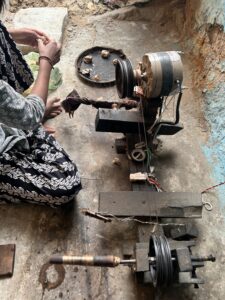
The introduction of powerlooms has not improved their situation either. Although powerlooms produce fabric nearly twice as fast as handlooms, workers are paid less per hour to offset the increased output. Speed has replaced skill, and efficiency has replaced dignity.
Their living conditions reflected everything they spoke about—no fan, insufficient lighting, and children studying amidst constant noise. It was hard to believe that education could survive in such an environment.
The reasons behind their poverty are many. Together, they have triggered a slow shift away from silk to other materials sourced from nearby states that pay slightly better. Some families have already abandoned weaving altogether.
I couldn’t help but recall my childhood—shopping with my mother, where shopkeepers charged a premium for handwoven fabrics.
So the question remains:
If handwoven textiles are valued more in the market, why are the weavers not paid more?
This is not the story of a single weaver.
Across four villages and four different homes, unrelated by blood or circumstance, I heard the same story—repeated with unsettling precision. Different faces, different looms, yet the same struggle. When a story becomes this consistent, it is no longer individual suffering; it is a systemic failure.
Champa’s looms do not ask for sympathy—they ask for fairness.
The hands that create heirloom textiles should not be forced to live in deprivation. If weaving is to survive as a living craft and not a museum memory, its value must travel beyond showrooms and reach the homes where it is born. Until then, the rhythm of the loom will continue—not as a song of heritage, but as a quiet struggle for survival.